The chart exists already. It came from the band’s folder, from the arranger, or from a scan of the page you have read for years. Nothing needs rewriting: attach it to the song, place a few markers, and it turns its own pages.
Attaching the file
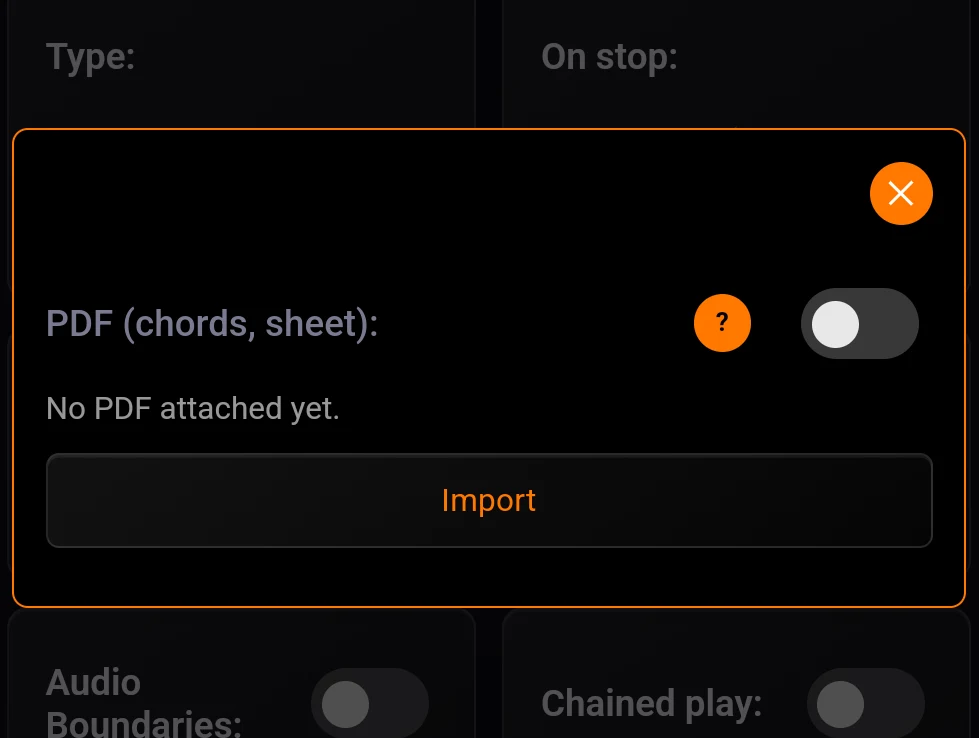
Tap the “PDF (chords, sheet):” card. Its window says “No PDF attached yet.” and offers “Import”. Pick the file off the phone.
The limit is 20 MB. Anything bigger is refused and told to you, and nothing changes. A photographed scan can easily be over that, in which case export or print a smaller version.
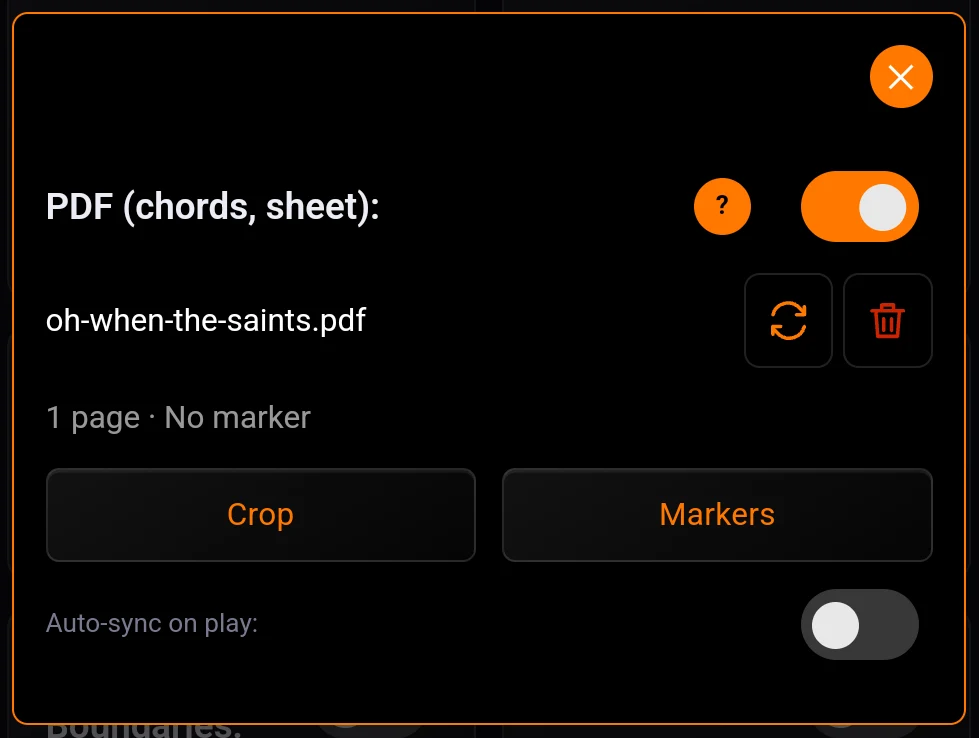
Once it is in, you see the filename and a line summarising it, such as “3 pages · No marker”, growing to “3 pages · 4 markers · cropped · rotated 90°” as you work.
Two small icons sit on the filename line: circular arrows to “Replace” the file, and a bin to “Delete” it. Delete asks first, with “Remove the score?”.
Below that, the two buttons that matter, “Crop” and “Markers”, and an “Auto-sync on play:” switch.
Replacing the file wipes the crop, the rotation and every marker. They describe pages that no longer exist, so the app clears them rather than leave you with turns landing in the wrong place. Get the export right first, place the markers second.
Crop and rotate
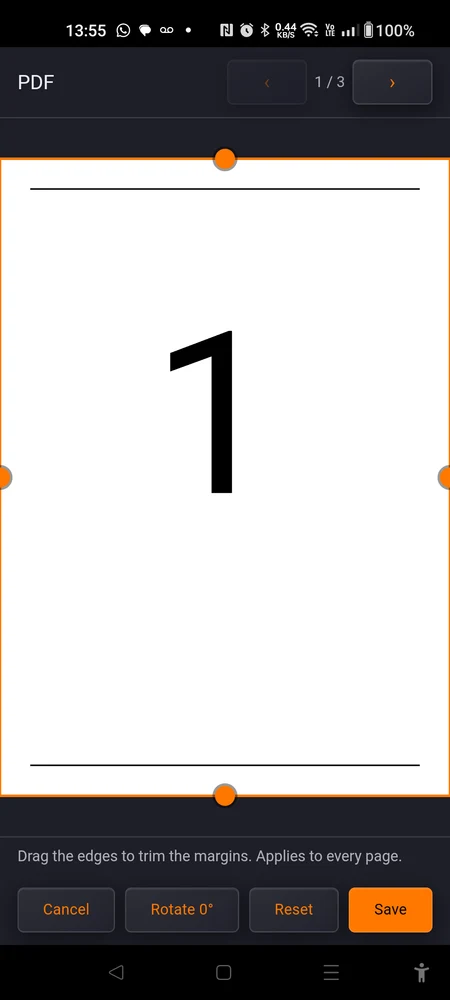
“Crop” shows a whole page with a draggable edge on each side. Pull the edges in and the margins outside them dim: what is dimmed is what gets trimmed. The hint says it plainly, “Drag the edges to trim the margins. Applies to every page.”
One crop for the whole document, so step through the pages with the arrows in the header and set it on the page that needs the most room. The trim cannot swallow the page entirely; there is a floor at a twentieth of it.
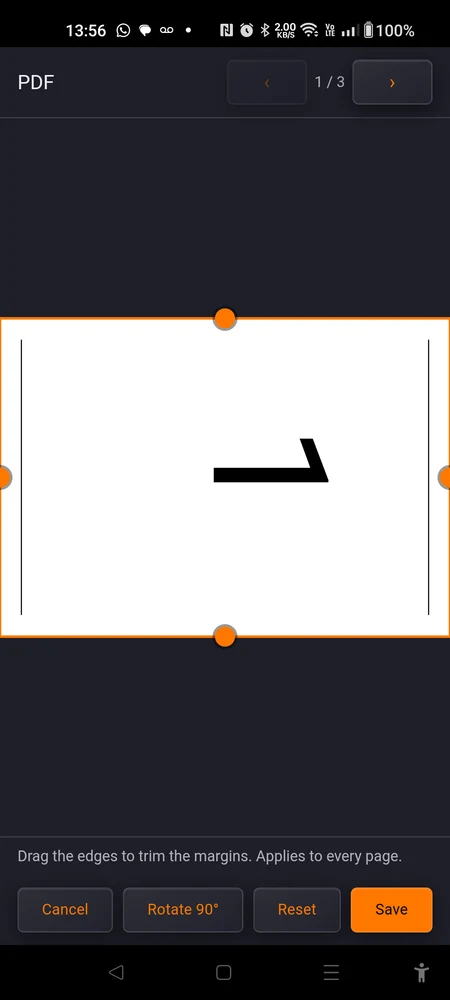
“Rotate {n}°” turns the page a quarter at a time, and the number on the button tells you where you are. Rotating puts the crop back to the full page, because edges you trimmed on an upright page trim the wrong sides once it is on its side. So rotate first, then crop.
“Reset” puts both back to nothing. “Save” keeps them, “Cancel” drops them.
None of this touches your file. The crop and the rotation are settings on the song, applied when the page is drawn, so the original PDF is left exactly as it was.
Markers
A marker says one thing: at this moment, be on this page, at this height.
The workflow is the same idea as a lyrics mark, done with your eyes instead of a cursor. Tap “Markers”, then:
- Play the track with the ▶ button.
- When you hear a place you want to be reading, scroll the page so that spot is in the middle of the view.
- Tap ”+ Add marker” (”+ Add” in landscape).
It stamps the time you are at, the page you are looking at, and the height at the centre of the view.
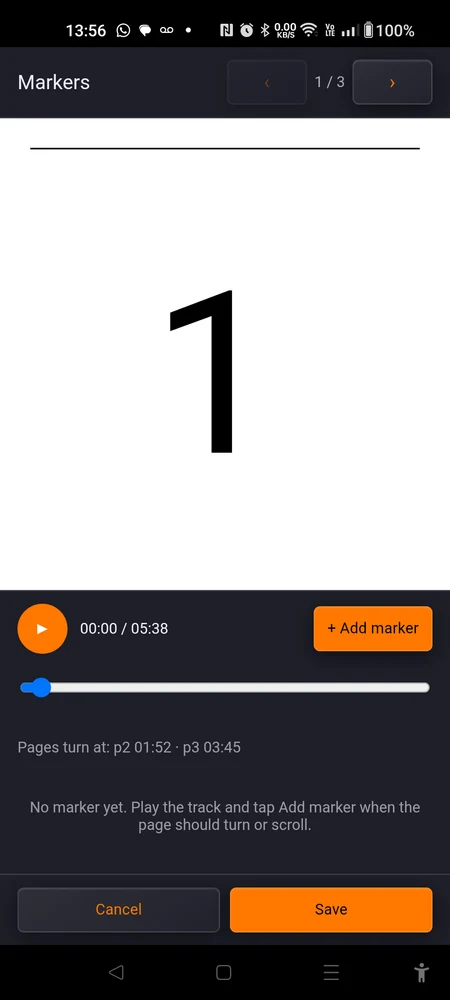
Placed markers are drawn on the page as a line with a small tag on it, numbered and timed, like “2 · 01:12”. Drag that tag up or down to move the marker on the page. The line itself is not draggable, so you can still scroll the score with a finger anywhere else.
Each marker also gets a row in the list:
| What you see | What it does |
|---|---|
the time, 01:12 | tap it to play from there |
| ”⤓“ | moves this marker to the current playback position |
| ”‹ 2 ›“ | steps the marker’s page down or up |
| a percentage | the height on the page, for reference |
| ”✕“ | deletes the marker |
The ”⤓” button is the one to remember. Rather than aiming for a perfect tap, drop the marker roughly, then play up to the exact bar and tap ”⤓” to move it there.
“Pages turn at:” shows the times each page will actually appear, worked out from your markers. Read that line before you trust the score on stage. A turn is the one thing you cannot fix mid-song, and one that lands halfway through a phrase is a turn you will be fighting.
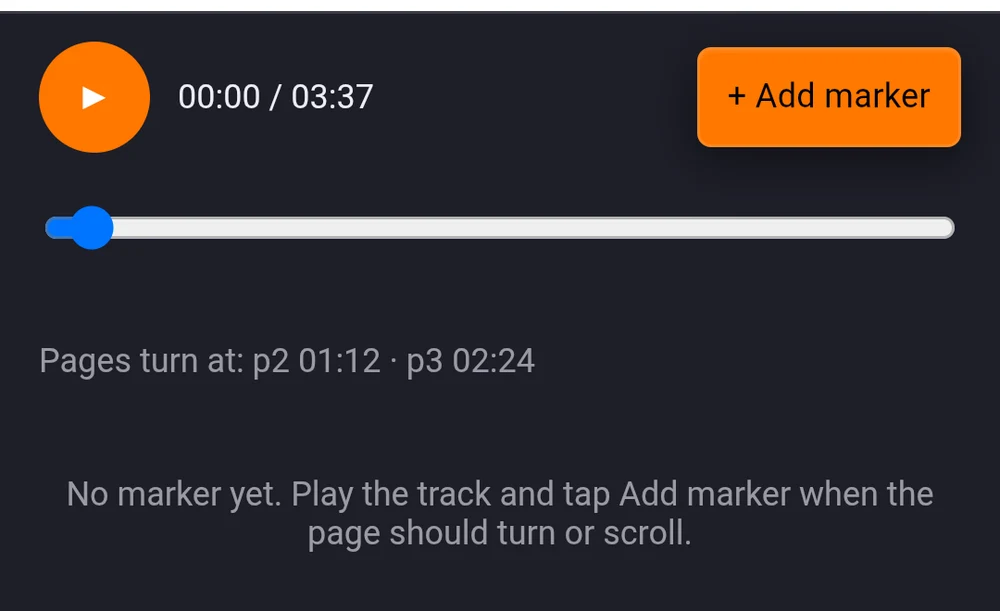
Markers must advance in time, and two at the same instant count as broken. You get ”⚠ Markers must advance in time:” with the pair named, and “Save” greys out. Two taps at the same second replace each other rather than stack up, and the app says so: “Marker at 01:12 replaced”.
Leaving the editor stops the track, so you land back in the set with nothing playing.
Marker times are counted from the moment the song starts playing, exactly like lyric marks. Retrim the pad’s start and every marker shifts with it.
What markers do on stage
Think of the whole document as one long ribbon of paper: page 1, then page 2, then page 3. The song walks down that ribbon at a steady pace, and a page turns when the ribbon crosses a join.
Markers are pins in that ribbon. Between two pins the pace is whatever it has to be to arrive at the next pin on time. One mechanism, three behaviours:
- No markers at all. The pages spread evenly over the song, the same idea as unmarked lyrics. Two pages, three minutes, and the turn lands at 1:30.
- Two markers on the same page. The view scrolls down that page between them.
- Two markers on different pages. The page turns at the moment the ribbon crosses the join, somewhere between the two.
A worked example. Three pages, a three minute song, and a single marker: at 1:00, be halfway down page 2.
- Getting there covers all of page 1 and half of page 2, so one and a half pages in sixty seconds.
- Page 1 on its own is two thirds of that distance, which takes forty seconds. Page 2 appears at 0:40.
- After the marker there is a page and a half left and two minutes to cover it. Page 3 appears at 1:40, and its bottom arrives as the song ends.
Which is exactly what “Pages turn at:” reports for that marker:
p2 00:40 · p3 01:40.
Two things fall out of this that are worth knowing:
- You never need a marker at the end. The song always finishes at the bottom of the last page.
- A marker may send you backwards, so a repeat works. Mark the head of the section again, later in the song, and the score scrolls back up to it.
A page that fits entirely on the screen has nothing to scroll, so on a chart like that the only thing you ever see is the turns. Same arithmetic, nothing special to set.
On stage
Deliberately the same view as the lyrics, so knowing one is knowing both. An “Auto-sync” switch, the countdown, stop and close, plus a page badge on the right reading something like “2 / 4”.
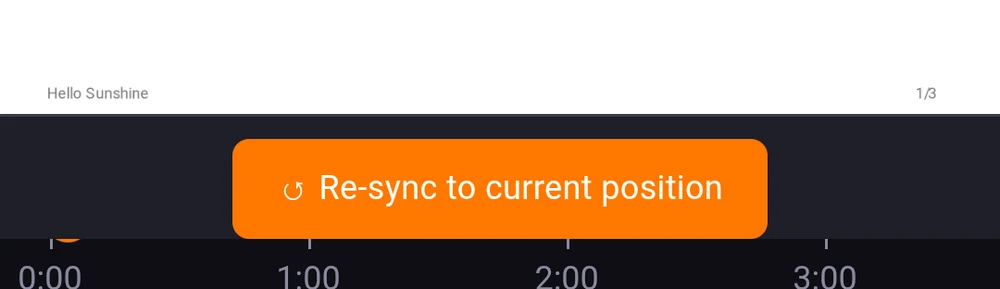
Drag the score and you take over: auto-sync goes off and the page stays put. ”↺ Re-sync to current position” hands control back. In landscape with live mode on, where there is no height to spare for a banner, that control shrinks to a single ”↺” beside the switch.
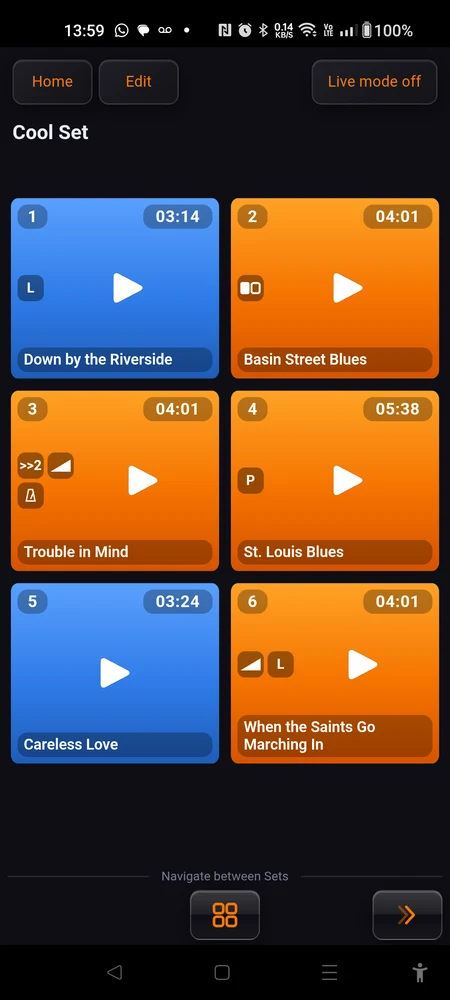
The pages are drawn in the background when you open the set, so a turn never waits on the phone. If you attach a score minutes before you go on, open the set once and give it a moment to settle before the first song.
If you still have to make the chart
This page is about displaying a score. Building one is a different job, and there is a free app for it.
You can also write the chart inside Stage Player, bar by bar, and then it follows the track by itself rather than turning pages at marks: Chord charts.
Chord Analyser lays out a full chord chart on the phone, sections, repeats and all, and exports a clean printable PDF. Export it there, import it here, and the same chart that went to your bandmates is the one turning its own pages on stage.
Where to go next
- Chord charts to write one in the app instead.
- Lyrics for words that scroll, with or without chords.
- Preparing a pad for everything else a pad carries.