Sixty-four facts, several skills
The tables from 2 to 9 hold sixty-four facts, from 2 × 2 to 9 × 9. A child who "knows them" can do several different things with each one:
- recall it: 7 × 8, and 56 comes without counting;
- check it: hear 7 × 8 = 54 and know it is wrong;
- turn it round: 8 × 7 is the same fact, not a new one to learn;
- run it backwards: 56 shared between 7 is 8, and 56 is 7 × 8;
- rebuild it when memory fails: count in sevens, add 7 eight times, double 7 × 4;
- do all of that quickly, so the tables are a tool and not a task.
A list of sums to answer mostly trains the first. The others need different situations: something to share, something to count in rows, something to double. A story can supply as many situations as it has places.
Why the story matters
In Multiply, an exercise never announces itself as one. Somebody asks for help. The baker's three children keep arguing at the table. Ronalf the giant needs logs for his cart. A colony of bats wants to sleep. A polite golem guards a bridge and recites his tables to stay awake, getting them wrong.
The reward is in the story too: a basket of food for the road, a lantern that shines further, a potion for the mine, a truce, a bridge you may cross. And each mini-game sits where the table it uses has just arrived. The cauldron that doubles is in the scene where Naomi learns the power of ×4; the golem who muddles his 5s is in the scene after the ×5 power.
Recall: every answer is a spell
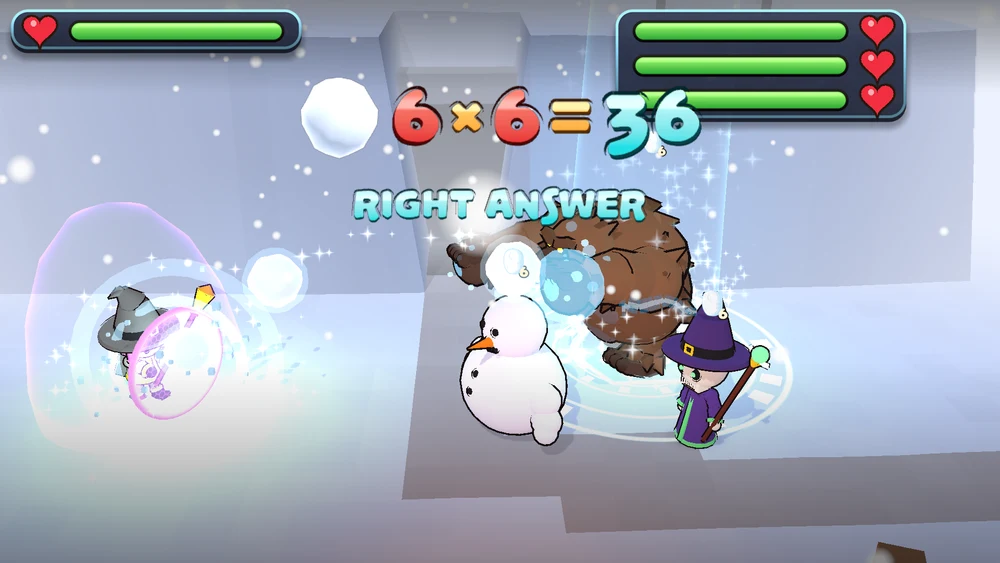
The duels are where recall happens most. The enemy announces its power and how many blows it will strike, six blows of 6 for instance, and the child types the product before the time bar runs out. Right, and Naomi's shield holds; wrong, and the blows land while the right answer smashes the wrong one on screen, so the last thing the child sees is the correct fact. Nothing to choose from, no answer to recognise in a list: the number has to come from memory.
Then it is Naomi's turn, and the question turns round. The game names a blow, 24, and she builds it from her own powers: the power of 6 four times, or the power of 8 three times. Any right way counts. Trolls, skeletons, yetis, wolves and ghosts, sometimes three at once: a fight lasts long enough to ask for a good number of facts, products one way and factors the other, and the child wants every one of them right.
The crossing is pure recall in disguise: a boat slips between the rocks if Naomi taps the buoy carrying the right answer, and when the boat hits a rock, the right buoy lights up, so a mistake always shows the answer. Near the end of the game, the ford comes back as Plank jump: a multiplication glows at the bottom of the water and Naomi has to jump onto the plank with the answer, tables 2 to 8 mixed.
Checking: the golem who gets it wrong
The muddled golem turns recall the other way. He recites his tables, mostly his 5s with some 2s, 3s and 4s, and gets about one in two wrong: "5 times 7… 53?" Thumb up if he is right, thumb down if he is wrong. Eight right out of ten and he lets Naomi cross his bridge without a fight.
Judging an answer is easier than producing one, which makes it a good step between the two. And his mistakes are the plausible kind: the fact next door in the table, the digits swapped, one or two out, or the two numbers added instead of multiplied.
Both ways round
7 × 8 and 8 × 7 are one fact for an adult and two for a child who has only practised one of them. Multiply keeps a separate record of each, so the one a child finds harder is the one that comes back.
Granny Pippin's vegetable garden makes the idea visible. She asks for a rectangle of lettuces, say 2 rows of 5, which Naomi traces with a finger on the plot. Then: "Now turn it: 5 rows of 2." Same lettuces, same number. Granny Pippin says it better than any rule: "Turn a rectangle and the number of lettuces stays the same!"
Hidden divisions
Division is never called division in Multiply. It turns up as sharing, as grouping, and as a missing number. Every attack in a duel is already one: 24 is asked for, and the child has to find what makes it. And of the 29 riddles, 16 are divisions written as a multiplication with a gap, 3 × _ = 9.
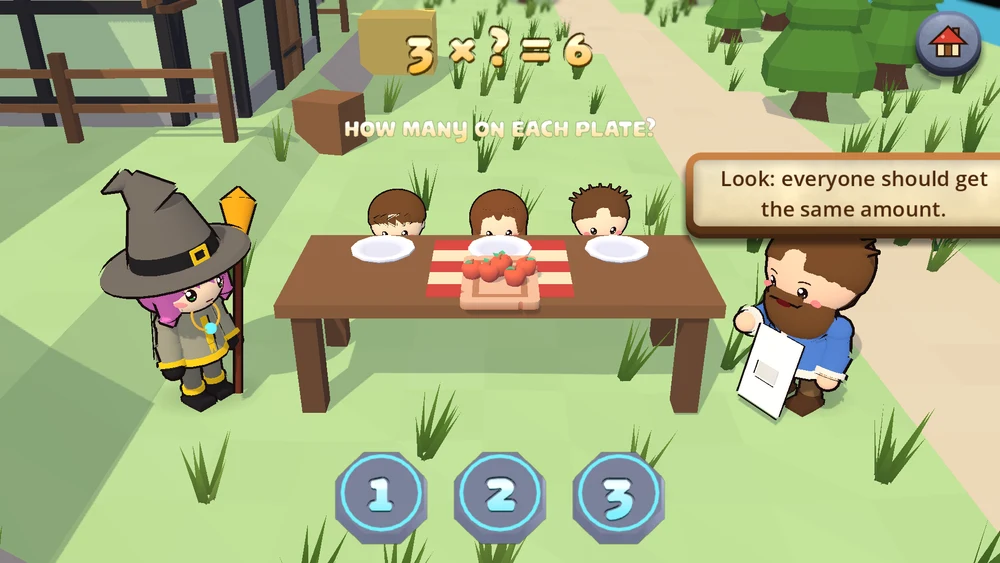
At the baker's sharing game, Naomi decides how much each child gets: the same on every plate, not a crumb more. The equation writes itself above the table as 3 × ? = 6. A later round asks it the other way: "3 each: how many children get some?" And the last round does not divide exactly, so one radish is left over, kept for tomorrow.
Ronalf's bundles asks for a number of logs in bundles of three. The rune lock, on Geoffroy's prison cell, has two wheels whose product must make the number carved on it: 18, then 42, then 12 twice, with two different combinations. Finding 3 × 4 after 2 × 6 is the moment a child sees that the tables cross each other.
Ways back to a forgotten fact
Children who forget 6 × 4 do not stay stuck if they have a route back to it. Four of those routes have a mini-game of their own.
Counting in steps
The stepping-stone ford, in the dwarves' cave, is crossed by jumping in twos, 2, 4, 6, then in threes, 3, 6, 9. A wrong stone goes splash and Naomi starts again. It prepares the 3 times table before the power of ×3 is even found. Later the same ford returns on ice, as the frozen river, with 4s, 6s and 7s, neighbours from other tables on the slabs as traps, and ice that cracks if Naomi waits too long.
Repeated addition
Ronalf's bundles start with "Load 4 bundles of 3 logs!" Naomi taps the pile, a bundle jumps into the cart, and then she counts the logs. Three, and three, and three, and three, is four threes: the moment where an addition becomes a multiplication.
Doubling and halving
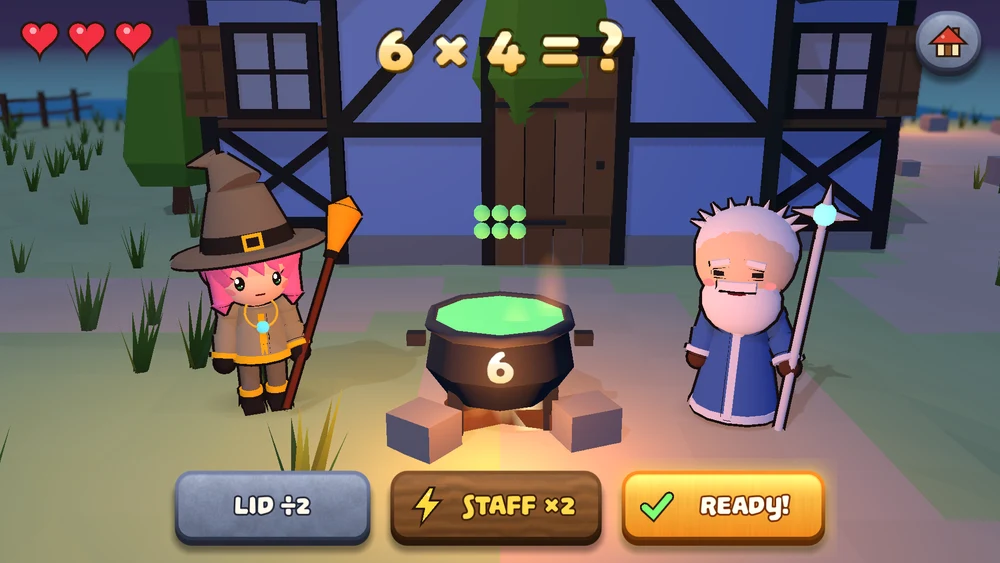
The doubling cauldron was bewitched by the fire that burned Naomi's house. Every tap of the Wizard's staff doubles what is inside, and the lid halves it. The Wizard needs 4 times 6 bubbles: 6, 12, 24. Two doubles make four times, which is exactly the trick for the 4 times table, and the 8s are a third double away. Granny Pippin's apples, much earlier, falls on the same idea at speed: tap the apple with the double on it before it lands.
Rows and columns
Bats on the ceiling lines the bats up for two seconds, then turns the lights off. Naomi gives the rows, the columns and the total. Two seconds is too short to count one by one, so the only way to win is to see 4 rows of 3 as 4 × 3. Win, and the bat boss grants a truce: one fight in the mine is avoided.
Memory, with near misses
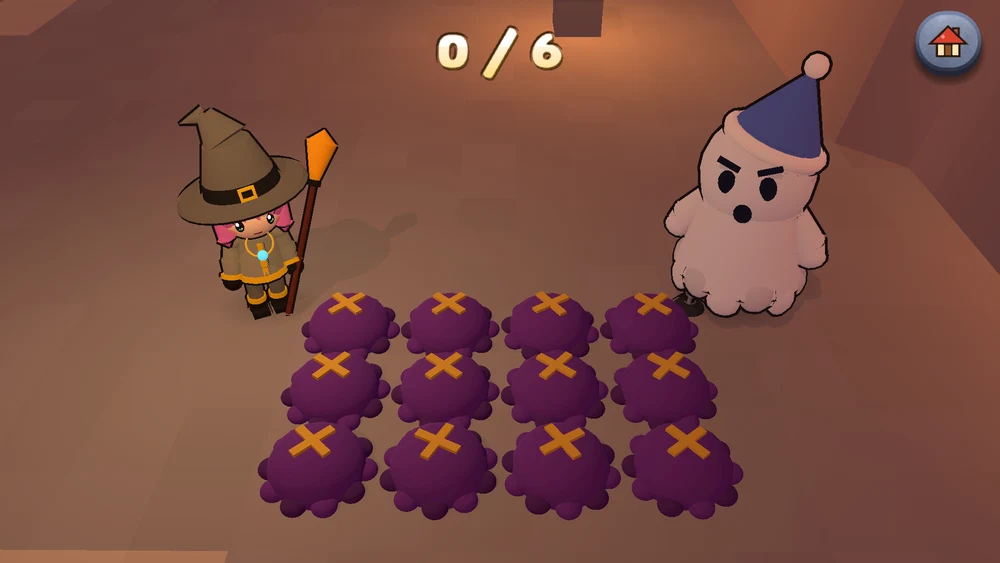
The ghosts' memory game is the card game every child already knows. Each sheet hides an operation or a result; lift two that belong together and a ghost flies free. The pairs are chosen to be confusing on purpose: 8 × 7 = 56 sits near 8 × 6 = 48, so a child who only half knows them has to look twice.
Speed, last
Knowing a fact and knowing it fast are not the same, and speed is where the mini-games put their gentle pressure: apples that fall, a plank that sinks, ice that cracks, bats that turn out the light, a golem who yawns. None of it costs more than a retry.
The duels speed up in steps. In the first scenes, each attack first plays out as a dream above the fight: the enemy fires its orbs one at a time and they are counted, so the child sees six blows of 4 before being asked what they come to. From the Wizard's duel in scene 3, the dream goes and the operation appears straight away, as a reflex. And the toughest opponents of each scene fight in a fury, their blows chained and the camera on the move.
Outside the story, for families who have the Parents' corner, Speed Battle lets a child choose the powers and the difficulty and fight for the pleasure of it.
The hard ones come back
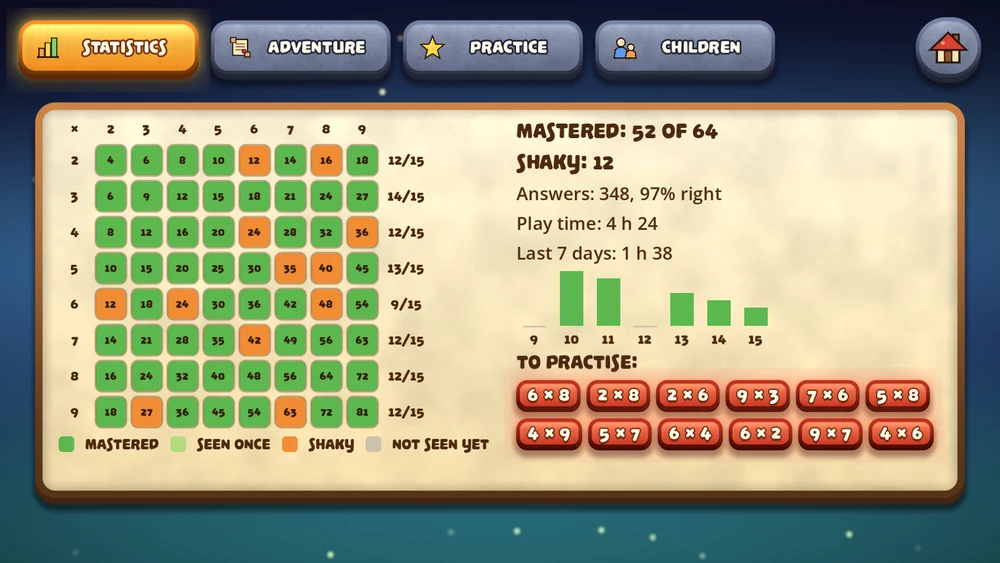
Behind all of this, the game keeps a record of every operation the child meets, both ways round. The duels do not draw their questions at random: each operation has a weight, which goes up when the child gets it wrong in a duel or takes a long time, goes up a little for its twin the other way round, and is halved by every quick right answer. The heavier an operation, the sooner it comes back.
It is not spaced repetition in the strict, flashcard sense, with a calendar of longer and longer intervals. It is simpler: what is shaky returns often, what is settled returns less, and the tables in play take turns so that a fight mixing ×7 and ×2 shows both. The child never sees the bookkeeping, only that the duels keep asking what they found hard, until it stops being hard.
Parents who buy the Parents' corner can see the same record: every operation, mastered or still shaky, table by table, and a revision aimed at the shaky ones.
Failing without losing
A mini-game can be tried again as many times as a child likes, and most of them open on a card with the rule and a "Later" button, which leaves without counting anything. Several are side quests the story does not need, like the garden, the baker's table, the cauldron or the rune lock. Two are alternatives to a fight, the golem's bridge and the bats' gallery: lose, and the fight that was always going to happen simply happens. The rest sit on the way forward, like the fords, the boat and the ghosts' wall, and those are built to be retried straight away.
All eleven at a glance
| Mini-game | Scene | What it practises |
|---|---|---|
| Granny Pippin's applesGranny Pippin and her apple tree | 1 | Doubles, against the clock |
| The stepping-stone fordA carved stone left by the dwarves | 2 | Counting in twos, then in threes Variant: The frozen river (scenes 9 and 11): counting in 4s, 6s and 7s, against the clockVariant: Plank jump (scene 13): tables 2 to 8 mixed, with a sinking plank |
| Granny Pippin's vegetable gardenGranny Pippin | 3 and 4 | Rows and columns, and a rectangle turned round |
| The baker's sharing gameThe baker and his three children | 4 | Sharing and grouping: division |
| Ronalf's bundlesRonalf the giant | 4 | Repeated addition becoming a product |
| The doubling cauldronThe old Wizard | 6 | ×4 as doubling twice, and halving |
| The crossingA boat between the rocks | 6 | Quick recall, the 4s mixed with the 2s and 3s |
| Bats on the ceilingThe bat boss | 7 | Reading rows × columns at a glance |
| The muddled golemA golem guarding a bridge | 8 | Spotting a wrong answer |
| The rune lockGeoffroy, a prisoner | 10 | Finding the two factors of a product |
| The ghosts' memory gameA grumpy ghost | 12 | Matching operations and results, near misses included |
With the Parents' corner, every one of them, variants included, can also be played on its own from the quick modes, and so can the 29 riddles, to practise one table in a few minutes.
Nicolas, maker of Multiply
Play them in the story
Multiply is an adventure for children aged 7 to 10, on Android. Free, no ads, no account.
Discover Multiply